Living and working in Northern New Jersey offers incredible opportunities, but it also comes with a significant drawback: noise pollution. From the constant hum of traffic in Newark and East Orange to the dense, multi-family housing developments in Paterson and Clifton, finding a quiet space can feel like an impossible luxury.
Whether you are a homeowner trying to build a peaceful nursery in Montclair, a professional setting up a permanent home office in Livingston, or a commercial developer erecting a new medical facility in Englewood, managing acoustics is a critical part of modern construction. Traditional fiberglass batts simply do not provide the acoustic barrier required for dense urban and suburban environments.
The ultimate solution to airborne noise and acoustic flanking is open cell spray foam insulation. In this comprehensive guide, we will dive deep into the science of sound transmission, explain why this specific type of foam outperforms older methods, and explore how United Spray Foam NJ can engineer a quieter, more peaceful environment for your property.
1. Understanding the Science of Sound in Buildings
Before we look at the solution, it is vital to understand the problem. In the realm of building science and acoustics, sound is generally divided into two distinct categories:
Airborne Noise
Airborne noise is exactly what it sounds like—noise that travels through the air. This includes people talking in the next room, a television blaring downstairs, sirens on the street, or a dog barking in the neighbor’s yard. Airborne noise travels in waves, and it will exploit any microscopic gap, crack, or seam in your walls or ceilings. This phenomenon is known as “flanking.” If air can get through a wall, sound can get through it just as easily.
Impact Noise (Structure-Borne)
Impact noise occurs when an object physically strikes the building structure, creating a vibration that travels through the wood framing, drywall, and floors. Examples include heavy footsteps on the floor above you, a door slamming, or a washing machine vibrating during the spin cycle.
When addressing noise in New Jersey homes and businesses, the primary focus is usually on eliminating airborne noise and dampening the vibrations that cause structure-borne noise. This is where spray foam insulation becomes an architectural necessity.
2. What is Open Cell Spray Foam?
To understand why it works so well for acoustics, we have to look at the chemical structure of the material.
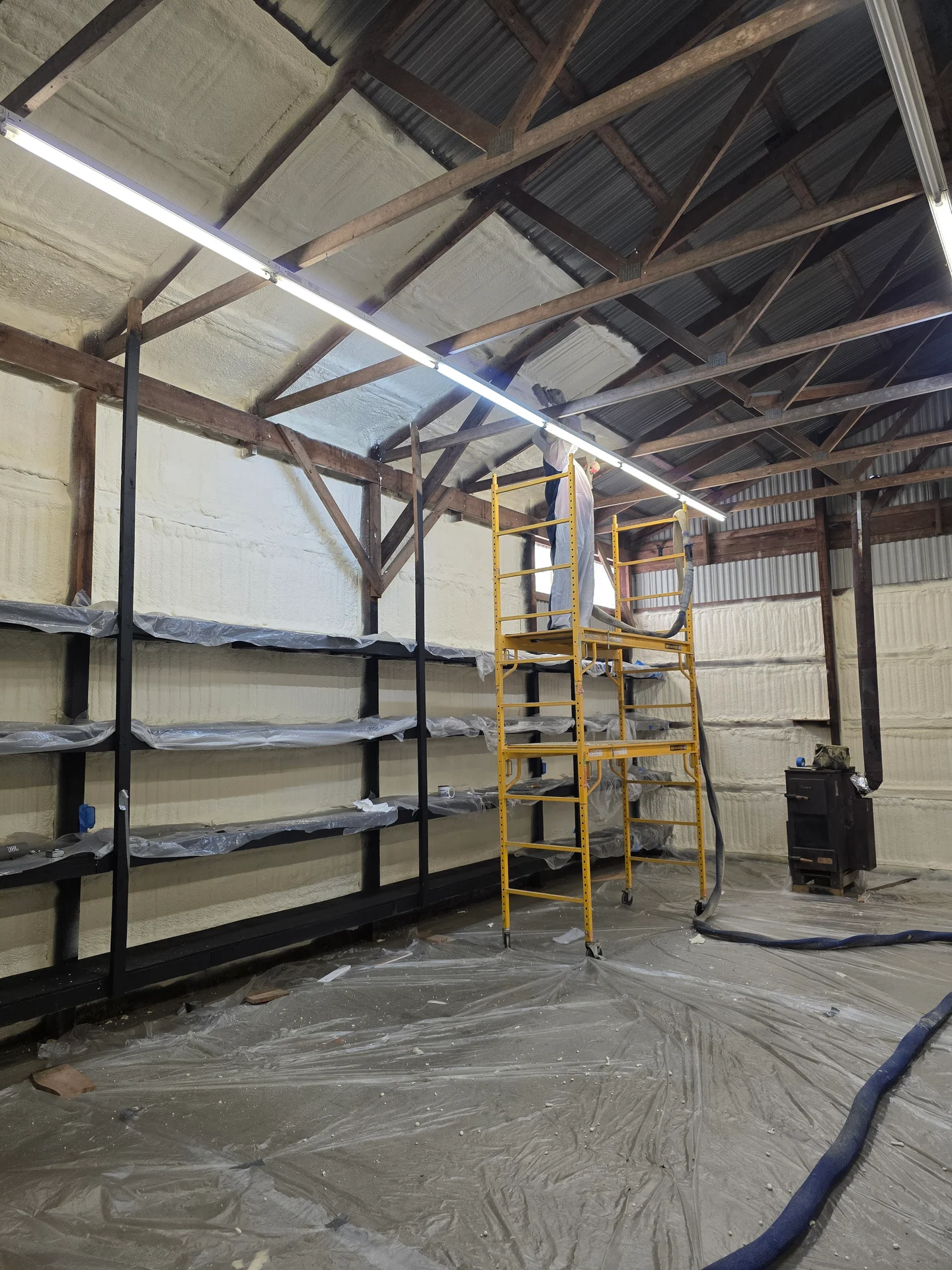
Open cell spray foam is a half-pound, low-density polyurethane foam. When our professional technicians mix the two chemical components (Side A and Side B) using high-pressure proportioning equipment, the liquid is sprayed onto the wall cavity or roof deck. Within seconds, it undergoes a massive chemical reaction, expanding up to 100 times its original liquid volume.
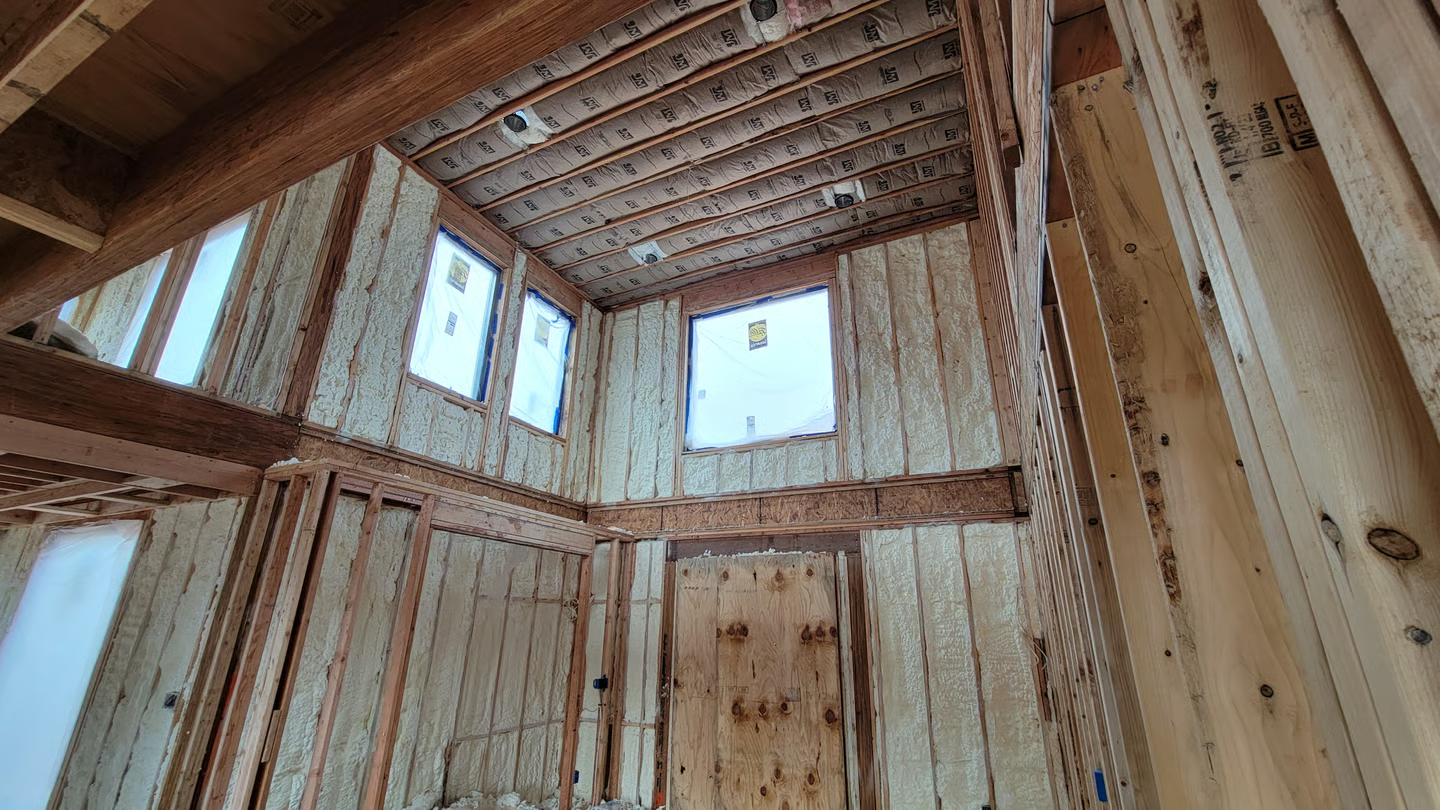
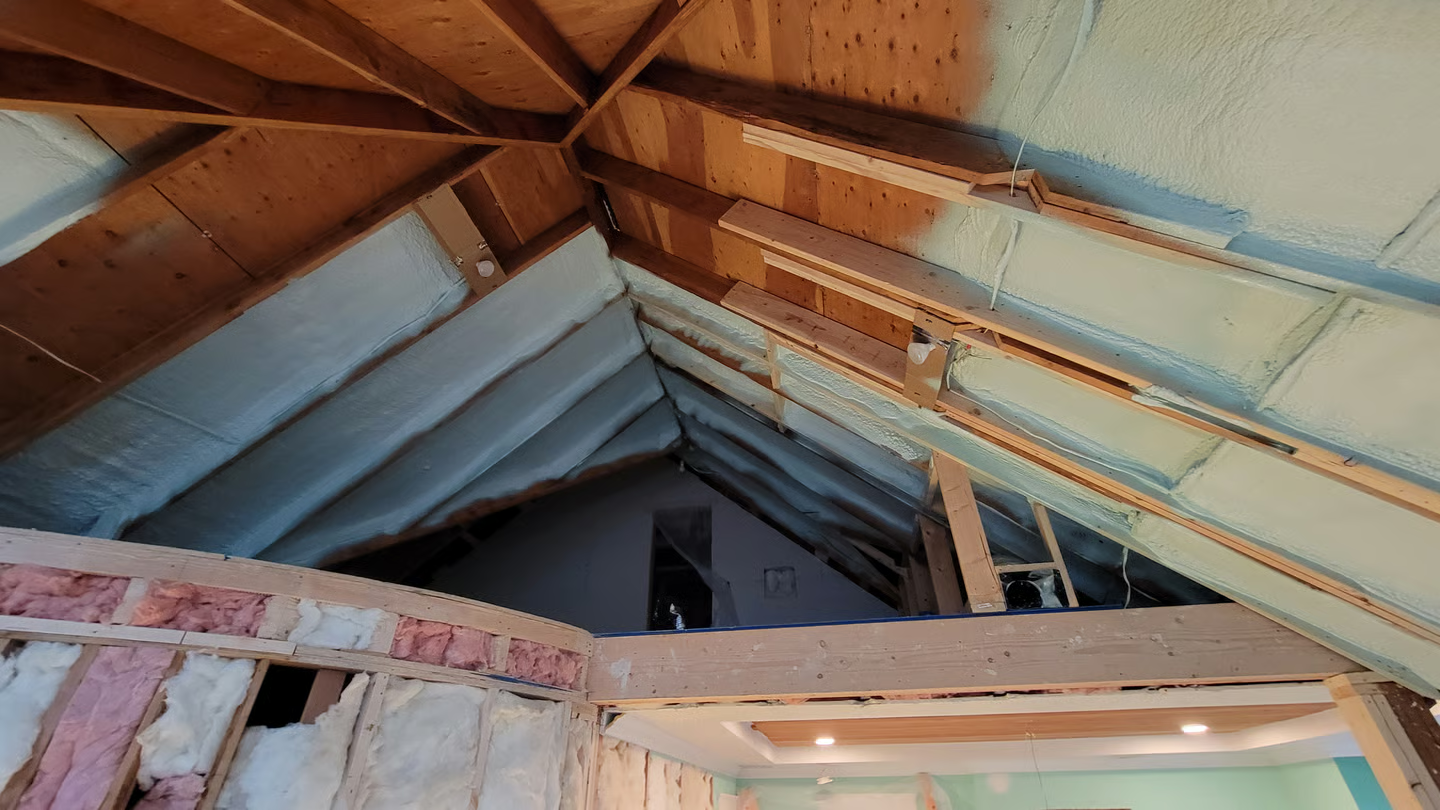
The term “open cell” means that the tiny bubbles (cells) that make up the foam are intentionally left open and not completely encapsulated. This creates a soft, flexible, sponge-like material. It is this exact physical structure—millions of microscopic, interconnected air pockets—that makes open cell spray foam insulation the premier choice for sound attenuation.
3. Why Open Cell Spray Foam Insulation Excels at Soundproofing
There are three primary reasons why architects and builders throughout Northern New Jersey specify this product for acoustic control:
A. The “Spongy” Density Absorbs Sound Waves
Unlike closed-cell foam, which dries into a rigid, rock-hard substance, open cell foam remains pliable. When sound waves hit a rigid surface, they often bounce off (causing echoes) or transfer their vibrational energy directly through the material to the other side. Because open cell foam is soft, it physically absorbs the sound wave, dissipating the acoustic energy into microscopic amounts of heat rather than letting it pass through the wall.
B. The Monolithic Air Seal Eliminates Flanking
As mentioned earlier, sound travels through the air. Traditional fiberglass insulation is cut into rectangular batts and stuffed between wooden wall studs. It is impossible to cut fiberglass perfectly enough to seal every gap around electrical outlets, light switches, plumbing pipes, and HVAC ducts. Sound easily “flanks” around the fiberglass through these gaps.
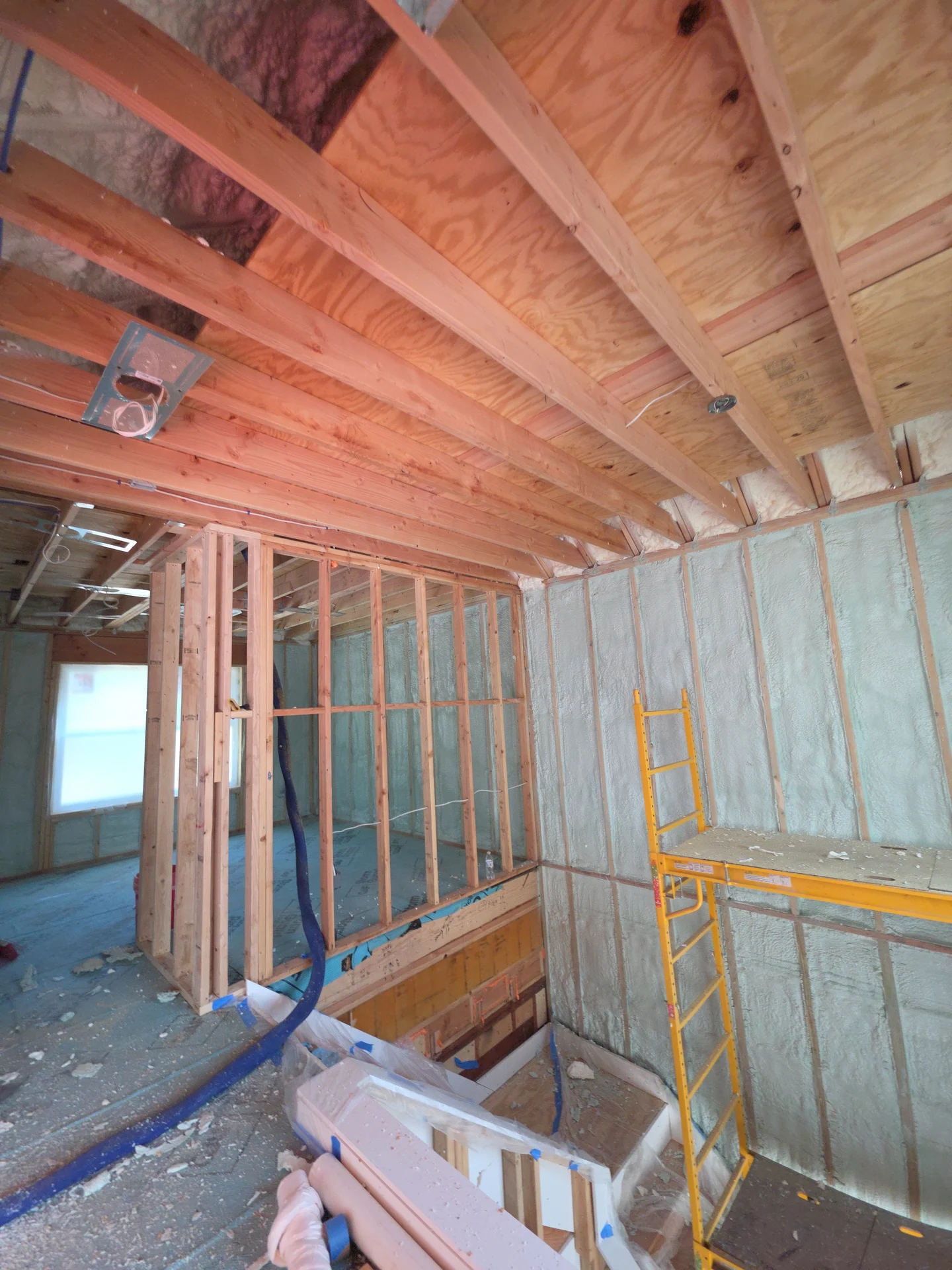
Because open cell spray foam insulation expands to fill the entire cavity, it creates a continuous, monolithic air barrier. It aggressively seals around all wires, pipes, and electrical boxes. By completely stopping airflow, you completely stop airborne sound transmission.
C. Superior STC Ratings
In construction, soundproofing is measured by an STC (Sound Transmission Class) rating. A standard interior wall with 2×4 framing, half-inch drywall on both sides, and no insulation has an STC rating of roughly 33 (loud speech can be understood clearly through the wall).
By filling that exact same cavity with spray foam insulation, the STC rating jumps significantly, often reaching into the low-to-mid 50s depending on the drywall thickness and framing technique. At an STC of 50, even loud shouting is barely heard, providing true privacy.
4. Key Areas to Soundproof in Your New Jersey Home
Homeowners across the state are realizing that comfort is about more than just temperature control; it is also about acoustic privacy. Here are the most critical areas in a home where we apply open cell foam:
The Master Suite and Bathrooms
If you are building a custom home in Wayne or renovating a historic property in Montclair, privacy is paramount. Spraying the interior walls surrounding the master suite ensures that plumbing noises from the bathroom, or conversations from the hallway, do not disturb your sleep.
Home Offices
With the permanent shift toward remote work, having a quiet space is no longer optional. If your home office in Livingston shares a wall with a noisy living room or a child’s playroom, open cell spray foam will block the domestic chaos so you can focus on your professional tasks and take Zoom calls in total silence.
Media Rooms and Home Theaters
If you are installing a high-end surround sound system in your basement, you want to keep the bass and explosions contained. Applying open cell foam to the basement ceiling (the floor joists of the level above) will drastically reduce the amount of noise that travels up into your kitchen or living areas.
Multi-Family Demising Walls
For property owners in densely populated areas like Clifton or Paterson, multi-family homes (duplexes and triplexes) are incredibly common. The “party wall” or “demising wall” that separates the two living units is the biggest source of tenant complaints regarding noise. Insulating this shared wall with expanding foam is the single most effective way to keep tenants happy and ensure they aren’t listening to their neighbor’s television every night.
5. Commercial Soundproofing Applications
The need for strict acoustic control is even more intense in the commercial sector. United Spray Foam NJ regularly partners with commercial developers to meet the exact acoustic specifications of complex facilities.
Medical and Dental Centers
Patient privacy is protected by federal law (HIPAA). When building a medical facility in Newark or Englewood, doctors must ensure that conversations in examination rooms cannot be overheard in the waiting room or the adjacent exam room. Open cell spray foam insulation provides the necessary sound barrier to guarantee patient confidentiality.
Corporate Boardrooms and Law Firms
High-level corporate environments require discrete spaces. Soundproofing conference rooms prevents sensitive financial or legal discussions from echoing through the hallways.
Recording Studios and Broadcast Rooms
For the ultimate acoustic environment, open cell foam is often used in the exterior and interior walls of local New Jersey recording studios. It prevents exterior traffic noise from ruining a recording while simultaneously stopping the internal music from escaping the building and violating local noise ordinances.
6. Open Cell vs. Closed Cell: Making the Right Choice
While we are focusing on sound, it is important to clarify the difference between your two main spray foam options.
- Closed Cell Insulation: This foam is dense, rigid, and acts as an absolute vapor barrier. It is incredibly strong, adding structural integrity to the building, and boasts a massive R-value (up to R-7 per inch). It is the ideal choice for exterior walls, crawlspaces, and areas prone to moisture. However, because it is rigid, it is not as effective at absorbing sound waves.
- Open Cell Insulation: This is the acoustic champion. While it has a slightly lower R-value (R-3.5 to R-4 per inch) and is vapor-permeable, its soft, expanding nature makes it the superior choice for interior sound dampening and complex attic roof decks.
At United Spray Foam NJ, our engineers will assess your specific project to determine the exact right material—or combination of materials—to achieve your thermal and acoustic goals.
7. The United Spray Foam NJ Installation Process
Achieving a high STC rating requires more than just good material; it requires flawless execution. Improperly mixed foam will shrink, pulling away from the wood studs and creating air gaps that let sound right back in.
When you hire United Spray Foam NJ, you are hiring a team of certified experts who treat building science with surgical precision.
- Site Preparation: We fully mask off windows, doors, and flooring to protect your property from overspray.
- Climate Control: We monitor the ambient temperature and humidity to ensure the chemical reaction happens perfectly.
- Precision Application: Using top-tier proportioning equipment, we spray the foam to the exact depth required to fill the cavity and optimize sound absorption.
- Trimming and Cleanup: Because open cell foam expands so much, it often puffs out past the wood studs. Our team uses specialized tools to shave the foam perfectly flush with the framing, leaving a pristine surface ready for drywall installation.
8. Invest in the Quiet You Deserve
Whether you are trying to block out the roar of an East Orange highway or simply want to ensure your Wayne home remains a peaceful sanctuary, your insulation choices dictate your daily comfort.
Traditional fiberglass and cellulose simply cannot compete with the airtight, sound-absorbing technology of modern spray foam. By upgrading your interior walls and ceilings with open cell spray foam insulation, you are investing in a permanent, structural upgrade that adds tangible value to your property and peace to your life.
Ready to Silence the Noise?
United Spray Foam NJ is Northern New Jersey’s premier contractor for high-performance building envelopes and acoustic solutions. We serve the entire region, delivering uncompromised quality to every commercial and residential project.
Get In Touch Today for a Consultation:
- Phone: (862) 291-7686
- Office: (201) 819-4671
- Location: 199 Darlington Ave, Ramsey, NJ 07446
- Hours of Operation:
- Monday – Friday: 7:00AM – 6:00PM
- Saturday: 7:00AM – 4:00PM